Security and Reliability
Security
Since the Mobile product needs to collect user experience, performance, and availability data through code instrumentation, the entire system has high requirements for security and SDK performance consumption. The Mobile system ensures security through the following aspects.
Collection Security
Mobile only performs automatic instrumentation on system method classes and does not involve the collection of customer business data. It provides functionality for filtering special classes, allowing sensitive code to be filtered, after which the SDK will no longer perform automatic instrumentation on that code.
Transmission Security
-
Transmission Protocol: The SDK and DC end use encrypted HTTPS transmission protocol to ensure data security during network transmission.
-
Data Encryption: Data uploaded by the SDK is encrypted using "National Cryptographic Algorithm," and locally cached data is encrypted using the AES algorithm to ensure data security.
-
Data Verification: The digest of data uploaded by the SDK is encrypted using asymmetric encryption, effectively preventing data tampering. By adding unique identifiers to data uploaded by the SDK, replay attacks can be effectively prevented.
-
Enhanced Security: By configuring "iOS: Bundle Identifier" or "Android: SHA1 fingerprint" on the server side, it can effectively prevent fake apps (re-signed applications) from uploading garbage data.
Storage Security
Mobile uses a highly available storage architecture to store data, providing highly redundant and distributed high-availability storage solutions for each type of data storage, and providing sound automatic backup, recovery, and disaster recovery measures to maximize the security and reliability of data storage.
Account Security
Mobile provides a complete role and permission management system, allowing specific user or role access permissions to be set for each functional module and data item. Different roles and users can only access the functions and data they are allowed to access. Especially for sensitive business analysis and business data, access can be limited to specific users and roles.
Reliability
The reliability assurance mechanism of the Mobile SDK is as follows:
-
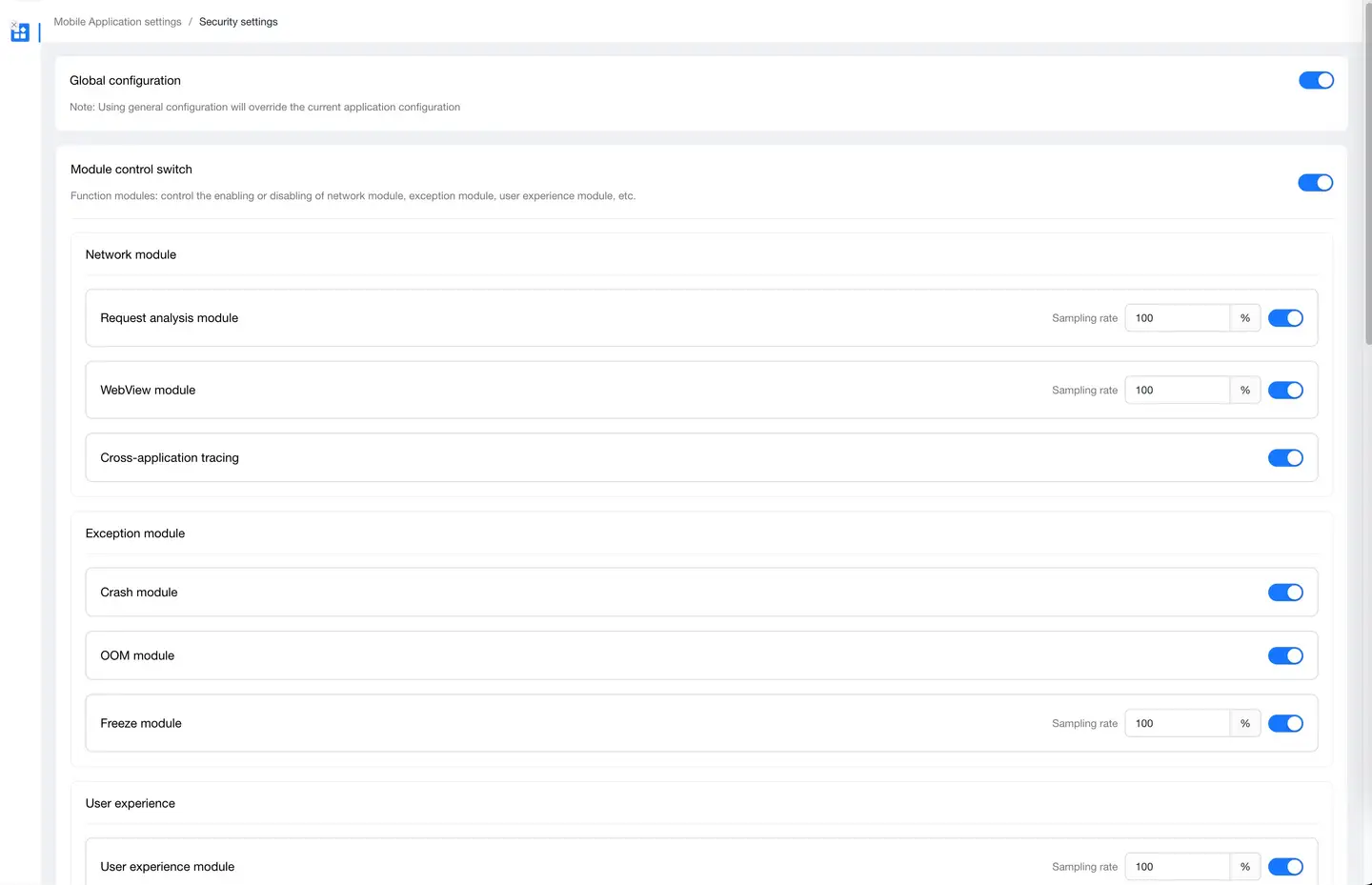
The App product provides corresponding "module control switches" for each functional module that can be remotely controlled with one click through reports. After turning off the control switch, it ensures that the SDK no longer instruments code or collects performance data.
-
When network anomalies occur, the SDK will locally cache the collected performance data, caching up to 10 minutes of data, following a "first in, first out" data aging rule, waiting until the network recovers before uploading again.
Privacy Data Collection
The Mobile product device information collection content is as follows:
| Client SDK | Personal Information Type | Collection Purpose |
|---|---|---|
| Android SDK | Device Information: Device model, device manufacturer, operating system name, operating system version, disk usage, memory usage, CPU information (model, architecture, usage rate), battery level, battery temperature, whether rooted, network traffic.\n\nApplication Information: Application name, application package name, application version, application UI orientation, application channel ID.\n\nNetwork Information: Network type, network connection type, carrier name, server IP address. | Obtain and statistically analyze application performance data on terminal devices |
| iOS SDK | Device Information: Device model, device manufacturer, operating system name, operating system version, disk usage, memory usage, CPU information (architecture, usage rate), whether jailbroken, network traffic.\n\nApplication Information: Application name, application package name, application version, application UI orientation, application channel ID.\n\nNetwork Information: Network type, network connection type, carrier name, server IP address. | Obtain and statistically analyze application performance data on terminal devices |
| Harmony SDK | Device Information: Device model, device manufacturer, operating system name, operating system version, disk usage, memory usage, CPU information (architecture, usage rate), network traffic.\n\nApplication Information: Application name, application package name, application version, application UI orientation, application channel ID.\n\nNetwork Information: Network type, network connection type, carrier name, server IP address. | Obtain and statistically analyze application performance data on terminal devices |
Note: According to the requirements of the Ministry of Industry and Information Technology's "Personal Information Collection Specification," the Mobile SDK does not collect customer sensitive information.